The quick version
- Skageflå, Knivsflå and Blomberg were working farms on shelves of rock above the fjord, reached by ladder, path and boat rather than by road.
- Roads, ferries and paid work in the towns drew families down from the meadows. What remains are stone walls, restored buildings and open fields kept clear of trees.
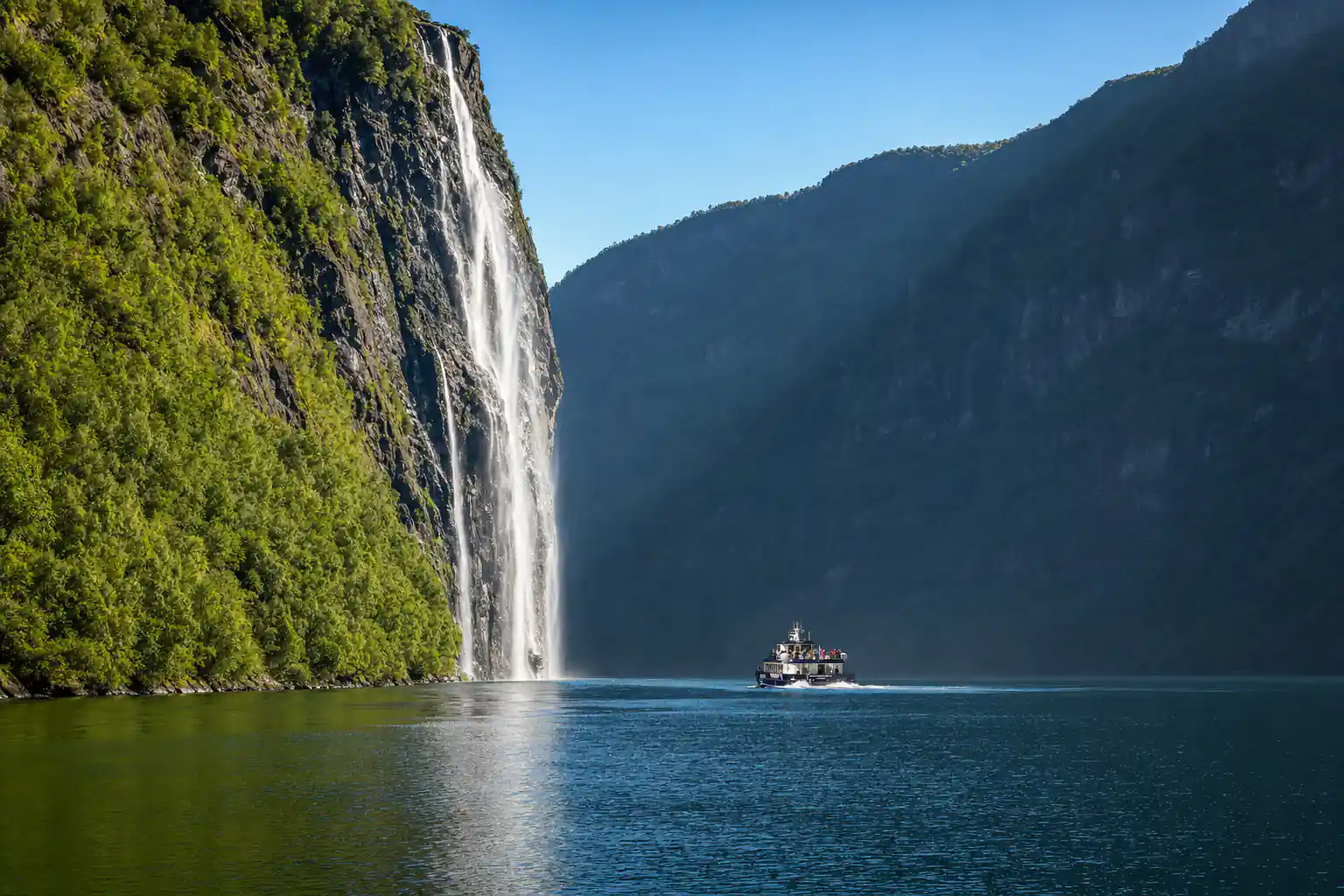
- Seven streams fall from one cliff, with the waterfall 410 meters tall in total and a free fall of 250 meters on the highest stream.[1]
- The Ålesund to Geirangerfjord round trip by hybrid electric boat takes 8.5 - 9.5 hours and starts from US$202, past the Seven Sisters and Friaren.[2]
- The Geiranger to Trollstigen scenic route is always closed in winter and normally open from mid-May to October/November, depending on when winter returns.[3]
- Top choice Geirangerfjord round trip from US$202 Duration8.5 - 9.5 hours[2]Rating4.75 from 758 reviews[2]Audio guideAudio guide included[2]CancellationFree cancellation up to 24 hours in advance[2] Check availability
- Boat to Geiranger, bus home from US$210 Duration10.5 hours[4]Rating4.60 from 140 reviews[4]Audio guideHost or greeter: English[4]CancellationFree cancellation up to 24 hours in advance[4] See this tour
- Winter cruise to Geiranger from US$325 Duration9 hours[5]Rating4.76 from 105 reviews[5]Audio guideAudio guide included[5]CancellationFree cancellation up to 24 hours in advance[5] See this tour
The largest number of cruise arrivals occurred in Bergen, with 328, followed by Ålesund with 290.
Is the Geirangerfjord round trip worth it?
Getting there and getting around
Geirangerfjord Skageflå and the Ledge Farms
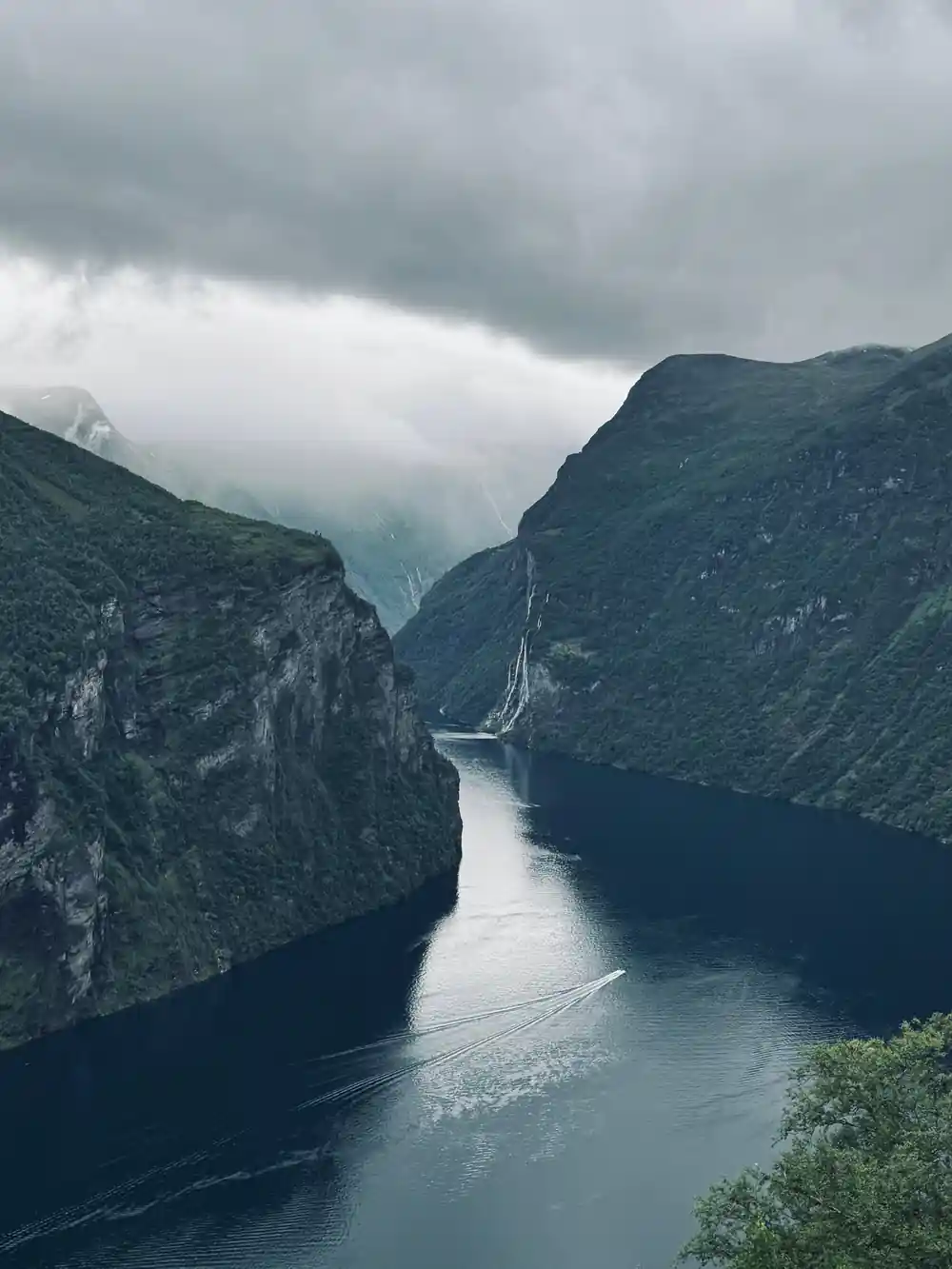
From the water, the old farms above Geirangerfjord look like a mistake. Small green shelves of meadow hang between bare rock and deep water, with a cluster of low buildings, a stone wall or two, and sometimes a ladder where a path should be. These were working farms rather than viewpoints. Hay was cut and dried on slopes so steep that a careless step ended in the fjord, and the working day began with a long climb from the water or a hard row across it. From a boat you notice the meadows first, then the roofs, then the small fields where a family once kept animals and grew whatever would survive the season.
Skageflå, Knivsflå and Blomberg are the names that come up as the boat passes. Each held a few families, a handful of animals and a strip of grass worth defending. Cows and goats were kept for milk, butter and cheese, and any surplus went down to the village by boat to be sold or traded. Children learned early how to move on ground that tilts away from them, how to read the weather off the cliff face, and how to get home before the wind picked up on the fjord. Hay was stored in small barns, and nothing that could be carried was left to waste.
Why the Farms Were Abandoned
The ledges emptied gradually, household by household, rather than in one dramatic season. Roads and ferries reached the valley floors, schools and clinics opened in the villages, and paid work in fishing, shipbuilding and tourism drew people towards the coast. A farm that demanded a stiff climb before the working day even started could not compete with a house that had a road at the door and a shop down the street. Families moved when the balance tipped, and once one household left, the neighbours' work became harder and the meadows harder to keep open.
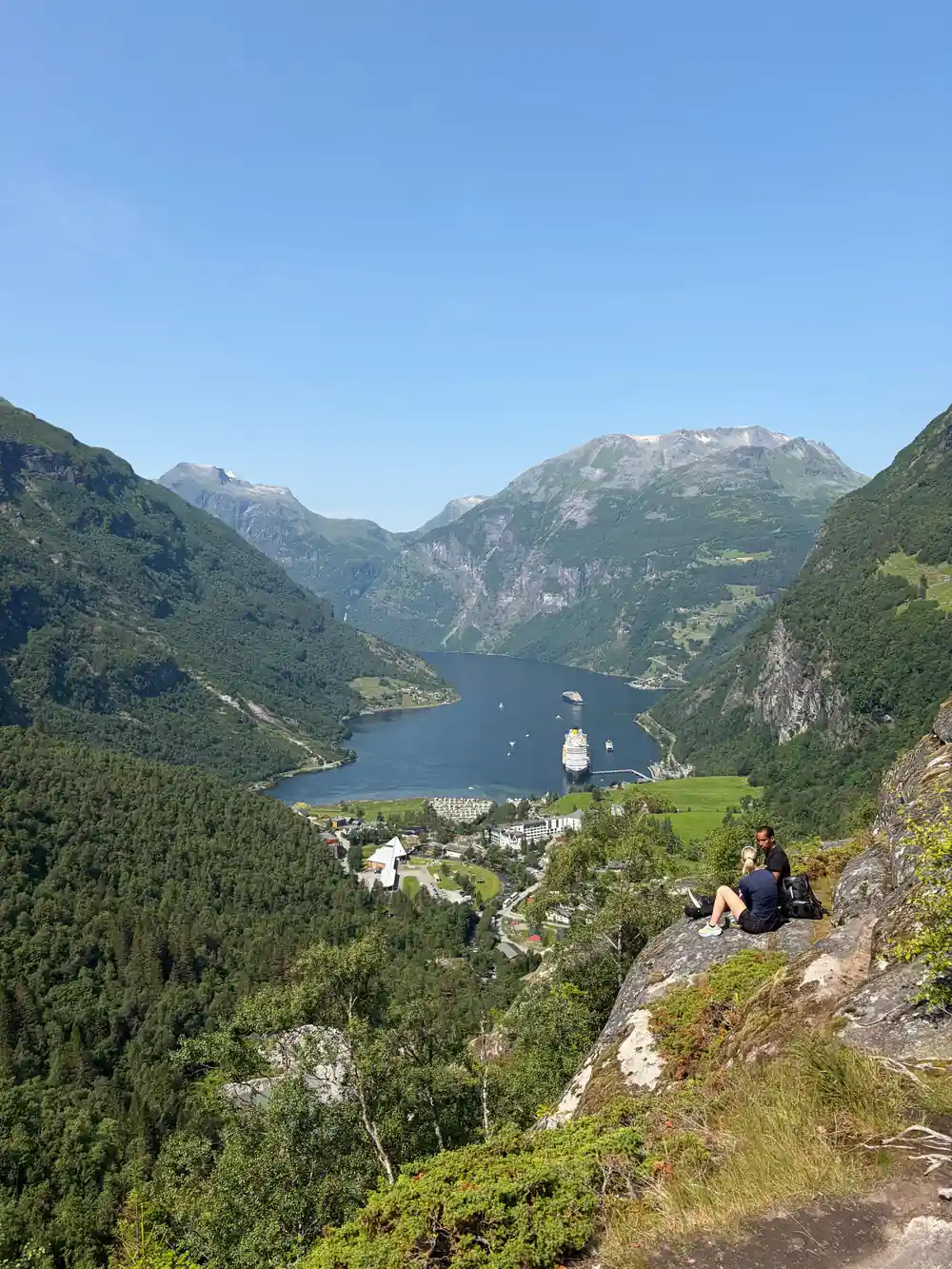
What is left is a kind of open-air memory. Stone walls run along the meadows, the footings of houses show where rooms once stood, and a few buildings have been restored so that the story survives rather than fades away. The water below the farms is deep and quiet, and on most crossings the boat engine is the loudest sound in the fjord. Walking up to one of these meadows, where a path exists, makes the old life easier to picture: the same view, the same wind, and none of the easy exits that a village offers.
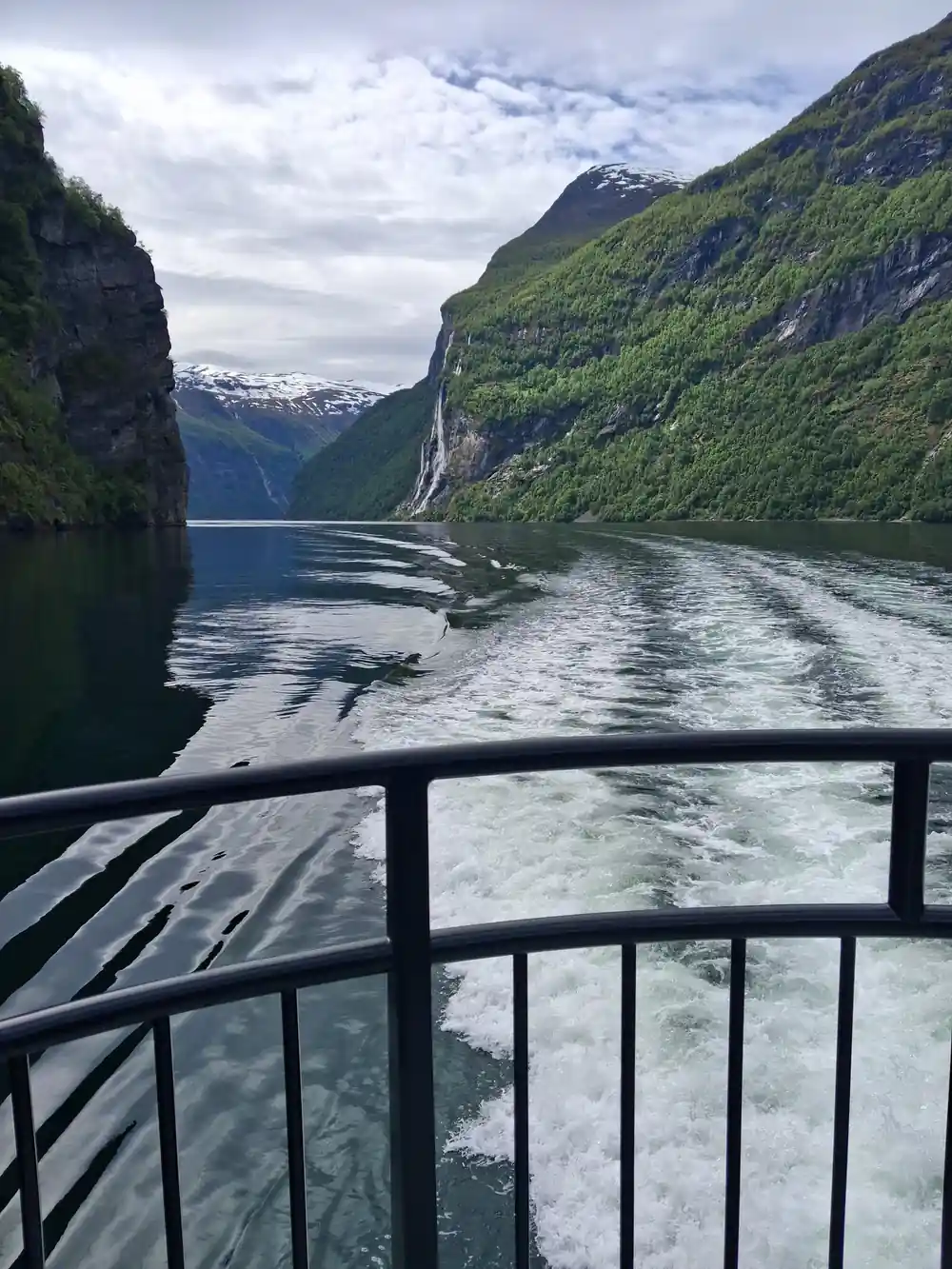
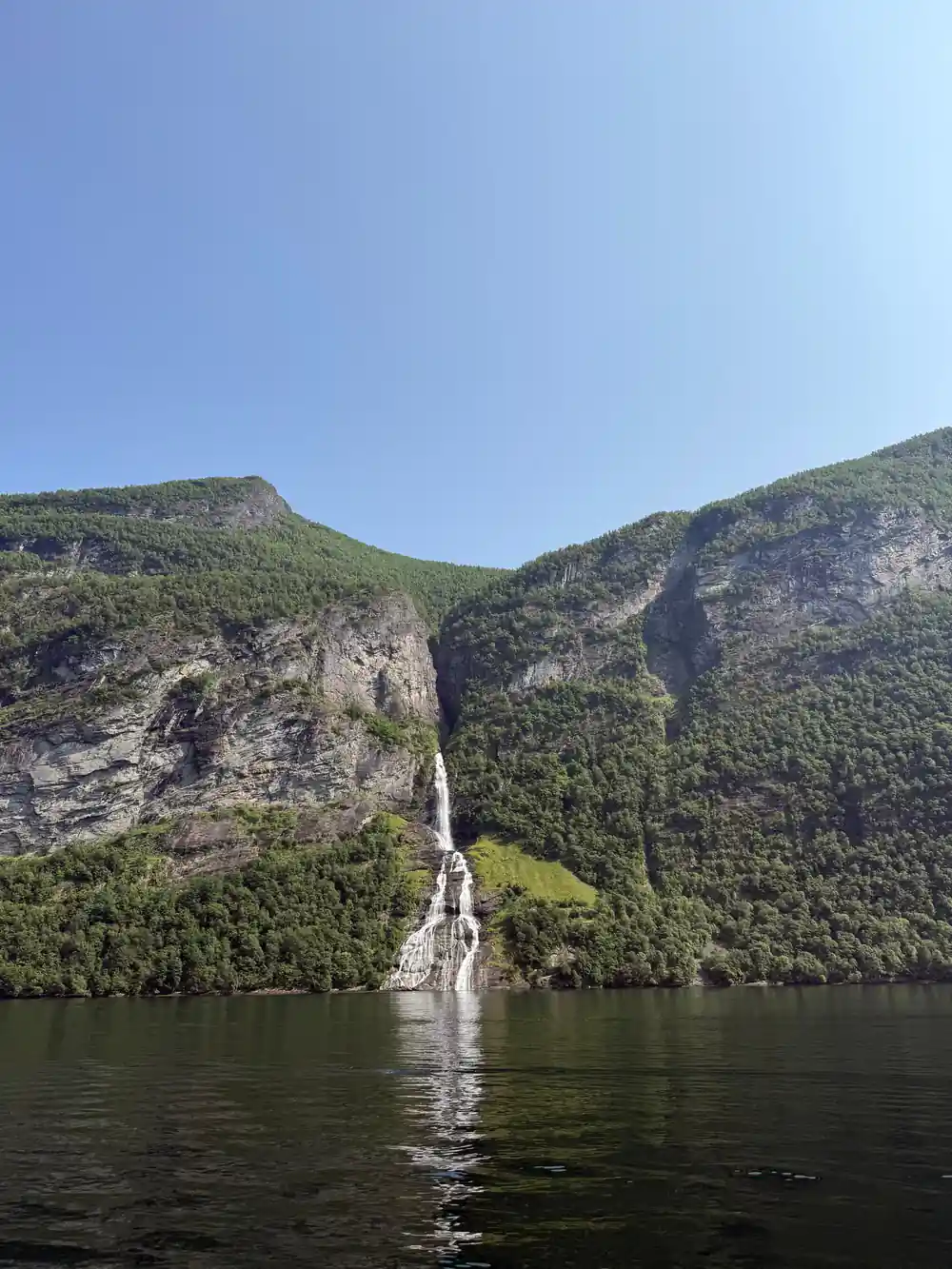
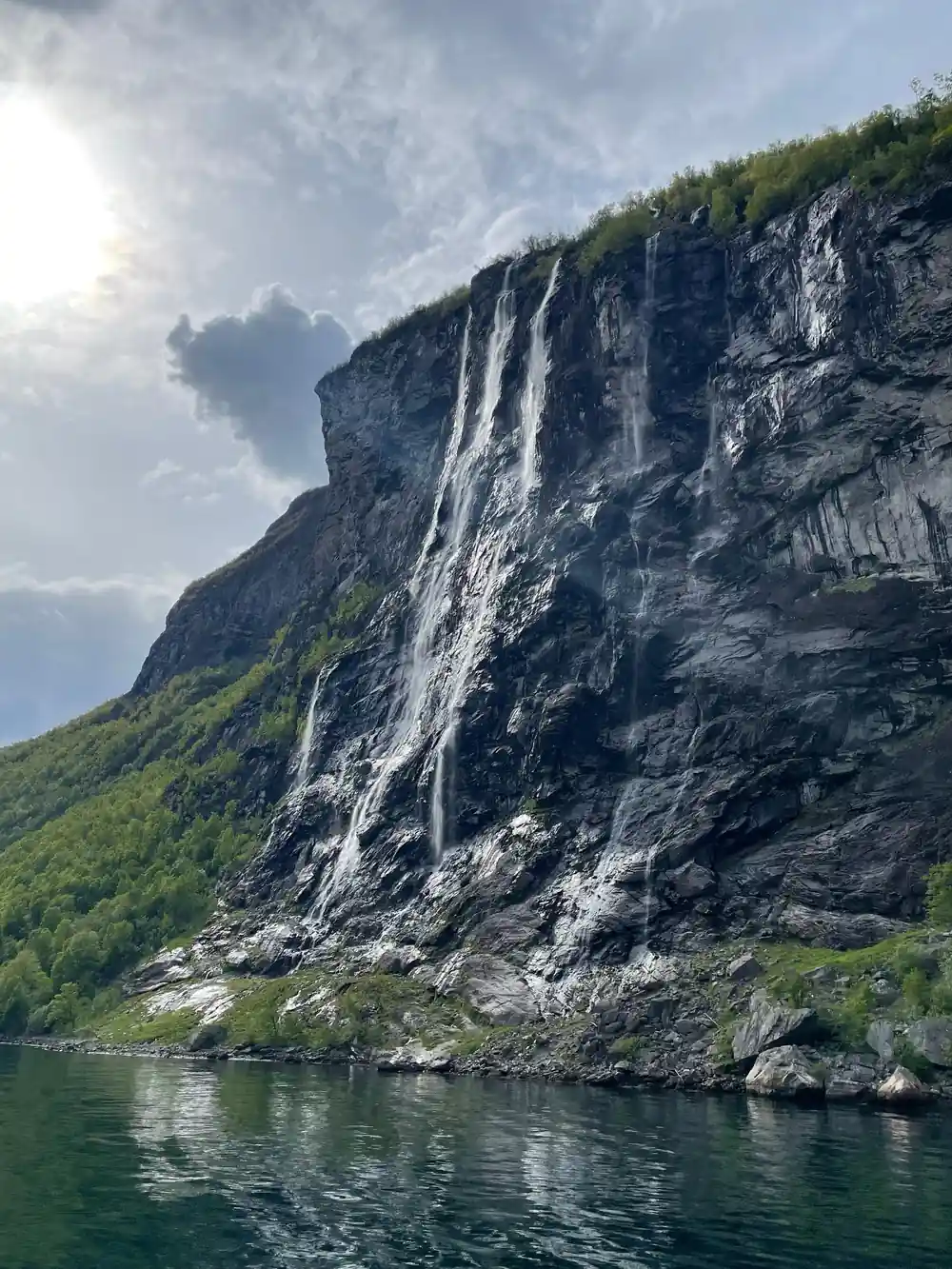
Waterfalls drop straight into the fjord below the old farm meadows.
The Legend of the Seven Sisters and the Suitor
The Seven Sisters are seven streams falling from the same cliff into the Geirangerfjord. The waterfall is 410 meters tall in total and the highest of the seven streams has a free fall of 250 meters.[1] Across the water, the single waterfall called the Suitor faces them, which is where the story comes from: seven sisters dancing down the rock, and a suitor on the other side, forever proposing and forever refused. The names do the work of a whole novel, and boats slow below the cliff so that everyone can look up at once.
The landscape around the two waterfalls is part of the West Norwegian Fjords, inscribed on the World Heritage List in 2005.[10] On a boat trip, that means you are looking at a listed landscape rather than only a photogenic one. Watch the cliff on the way in, while the boat is still a little way off and the whole face is in view, then look again on the return leg, when the light falls from a different direction and the streams separate into individual threads of water.
A Royal Breakfast on the Ledge at Skageflå
The story told about Skageflå is a breakfast eaten by royal guests. A table set in the open air on the farm meadow, with the fjord far below and the cliffs behind, turned a summer pasture into a symbol of a way of life that had almost gone. The pairing is what makes the story stick: a farm high on a ledge, hosting royal visitors, with nothing between the table and the water but grass and a steep drop.
The buildings on the ledge have been restored and the meadow is kept open, so from the water you still see a farm rather than a ruin. If you walk up to it, treat the place as a heritage site. Close gates behind you, keep off the old masonry, take your litter down with you, and do not expect a cafe, a ticket desk, or anywhere to shelter if the weather turns. The reward is a view that most travellers only ever see from below.
Getting up there takes effort, and the path is steep and can be slippery after rain. Many travellers see Skageflå the way the passengers on the early steamers did, from the water, with the farm framed by cliffs and a waterfall off to one side.
from US$202
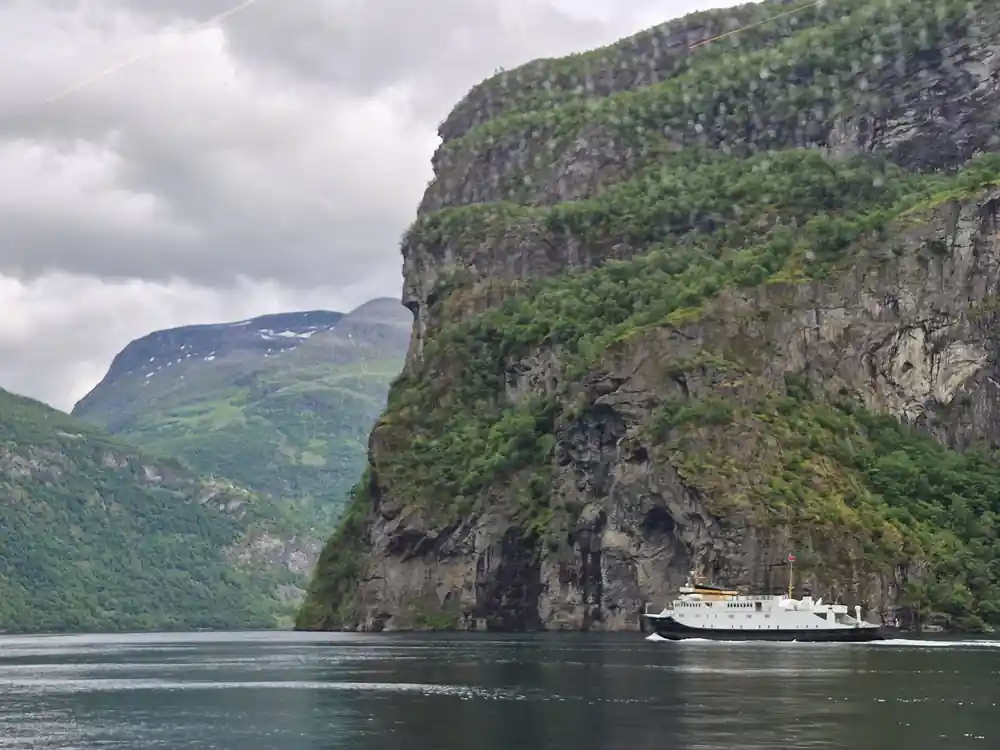
The Ålesund to Geirangerfjord round trip by hybrid electric boat runs past the Seven Sisters and Friaren and calls at Geiranger village.
Victorian Travellers Discover the Fjord
Long before a road reached Geiranger, visitors arrived by sea. Victorian-era travellers came on steamers, dressed for a promenade rather than a mountain, and wrote home about the scale of the cliffs and the roar of the waterfalls. The fjord became a destination for people who read a guidebook before they sailed, and their letters and sketches are part of the reason names such as Skageflå and the Seven Sisters feel familiar today, even to travellers who have never been here.
Seeing the fjord from the water is therefore older than the road network. For a long time the boats were the road: farmers rowed to church and to market, post and supplies came by sea, and visitors simply joined the same traffic and paid for a place on deck. A modern fjord cruise follows much the same line as those early steamers. What has changed is the comfort, not the route.
If you want to see what those early travellers saw, take a window seat on the way out and spend the return leg on deck. The light changes constantly, waterfalls swing in and out of view behind the boat's wake, and the farms on the ledges stay hidden as small green marks on grey rock until you are almost underneath them.
Kaiser Wilhelm II and the Fjord
European royalty made these waters fashionable. Kaiser Wilhelm II sailed the Norwegian fjords on summer cruises, and his visits, along with those of other crowned heads, helped turn the Geirangerfjord into an international calling card. Hotels, landing stages and a small industry of guides and boats appeared along the route for the passengers who followed. The habit of a summer cruise, in other words, is not a modern invention.
Ålesund belongs to that cruising story as well. The town burned during the night of 23 January 1904.[11] It was rebuilt in the years that followed, and the compact centre you walk through from the dock grew out of that rebuilding, close to the water and easy to cover on foot. If you have time before you sail, 418 steps lead from the town park up to the Fjellstua viewpoint on Mount Aksla.[12]
Travel by Boat Before There Were Roads and Ferries
For most of the fjord's history, if you wanted to move, you floated. Boats carried people, animals, hay and churchgoers, and the farms on the ledges stayed in touch with the villages below by water and by steep paths rather than by road. The old connections ran along the shoreline, from landing to landing, and that is still the line a fjord cruise follows today. Roads and ferries came later, and they changed the valley floors far more than they changed the cliffs.
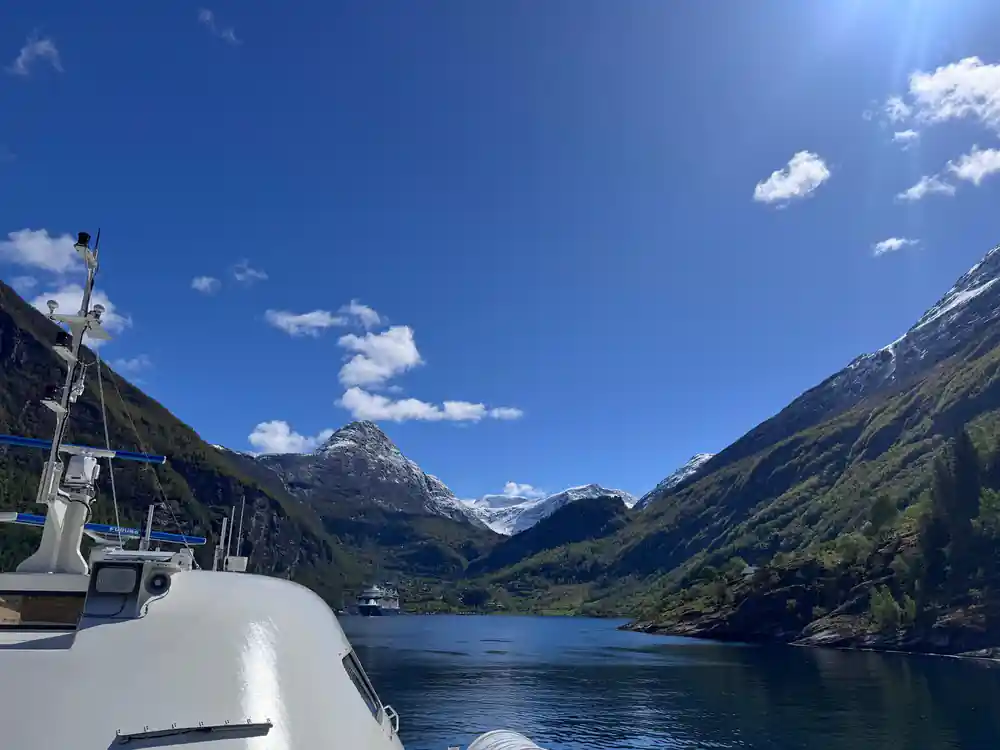
Today the shape of the journey is familiar. The round trip from Ålesund goes along Storfjorden and Sunnylvsfjorden into the Geirangerfjord, past the Seven Sisters and Friaren, into Geiranger and back, and it takes 8.5 - 9.5 hours, starting from US$202.[2] The boat is a hybrid electric one, with an audio guide, wheelchair access and free cancellation up to 24 hours in advance.[2] By land, Ålesund to Geiranger is 67 miles (108 km),[13] and the Norwegian Scenic Route Geiranger to Trollstigen is always closed in winter and normally open from mid-May to October/November, depending on when winter returns.[3]
From-prices for fjord trips leaving Ålesund
Fjord day from Ålesund: from-prices
When to go for the fjord farms
Plan your fjord day
Book the right departure
Check the starting times for your date and pick a departure that leaves you time to reach the boat without rushing.
Dress for the water
Layers, a windproof jacket and a warm hat. The village can be calm and mild while the fjord is cold and windy a few minutes later.
Move around the deck
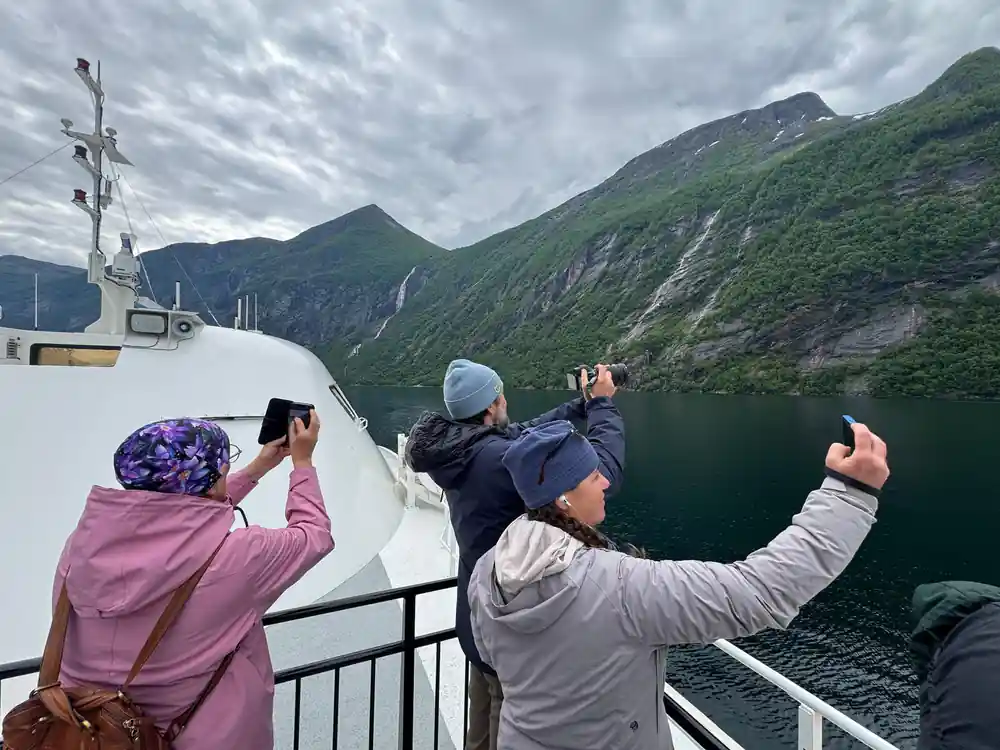
The cliffs, farms and waterfalls appear on both sides, so change position rather than staying on one bench the whole way.
Watch for the farms
Look for green shelves, old stone walls and small buildings on the cliff face as the boat passes below.
Leave time in Geiranger
The route calls at Geiranger village, so plan a short walk, a coffee or a look at the fjord from the shore before the return leg.[2]
Keep the plan flexible
Reserve now and pay later, and remember free cancellation up to 24 hours in advance for a full refund.[2]
See the cliff farms and the Seven Sisters from the water
from US$202Reserve now & pay later